Comments
Timelines
Contact
Social Media
Timeline Cover
Showing posts with label Islamophobia. Show all posts

Thursday, January 21, 2021

Islamophobia in western media is based on false premises Thursday, January 21, 2021

Although anti-Muslim sentiments certainly existed long before 2001, the Sept. 11 terrorist attacks and the response to them intensified anti-Muslim tropes, namely the presumption that Islam is inherently violent or that Muslims have a propensity for terrorism. Since 9/11, specific individuals have turned Islamophobia into an industry, scapegoating Muslims to further their own agendas.

Like other forms of intolerance, however, Islamophobia can be objectively assessed. Empirical studies are an effective means of exposing this prejudice, one that plagues both sides of the political spectrum.
Anti-Muslim rhetoric

The rhetoric of Canadian conservative author Mark Steyn is typical of right-wing Islamophobia. For instance, Steyn claims that “most Muslims either wish or are indifferent to the death of the societies in which they live.”

Likewise, Dutch politician and right-wing populist Geert Wilders refers to the Qur’an as “a source of inspiration for, and justification of, hatred, violence and terrorism in the world, Europe and America.” British conservative political commentator Douglas Murray suggests that to reduce terrorism, the United Kingdom requires “a bit less Islam.”


Prominent left-wing commentators also contribute to the same scaremongering stereotypes as their conservative counterparts. For example, American neuroscientist and new atheist Sam Harris asserts that “there is a direct link between the doctrine of Islam and Muslim terrorism.”

Similarly, American comedian and television producer Bill Maher believes that there is a “connecting tissue” of intolerance and brutality that binds 1.6 billion Muslims to terrorist groups like ISIS. And Somali-born Dutch American activist and writer Ayaan Hirsi Ali states that “violence is inherent in the doctrine of Islam.”

None of these characterizations, however, are sufficient from a scholarly viewpoint. Self-evident positions and gross exaggerations tend to detract from the main issue: whether the depiction of Muslims as violent extremists is misleading.
Most Muslims reject violent extremism

Globally speaking, Muslims overwhelmingly reject suicide bombings and other forms of violence against civilians in defence of Islam. Studies found that Muslims view such extremism as rarely or never justified, including 96 per cent in Azerbaijan, 95 per cent in Kazakhstan, 92 per cent in Indonesia and 91 per cent in Iraq.

The 2016 report What Muslims Want, the most extensive research of British Muslims ever conducted, found that nine of 10 British Muslims reject terrorism outright. When asked “To what extent do you sympathize with or condemn people who commit terrorist actions as a form of political protest,” 90 per cent condemned these actions, five per cent didn’t know and three per cent neither condemned nor condoned political acts of terror.

That’s hardly “most Muslims,” as Steyn contends.
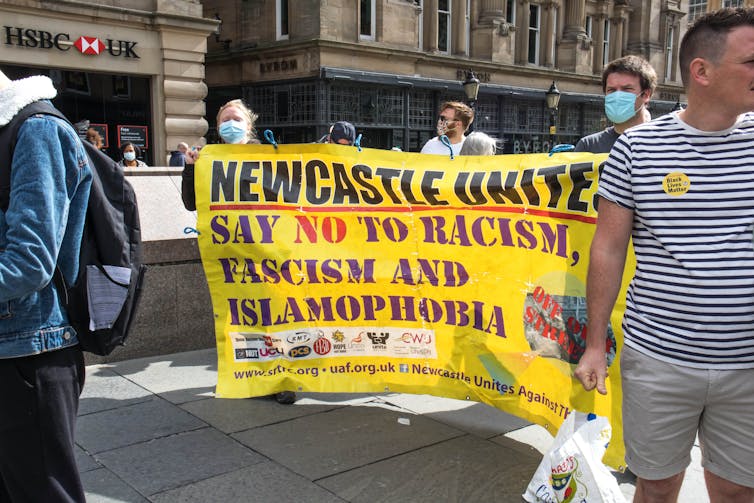
Protestors at a public rally carrying an anti-racism banner on Sept. 5, 2020 in Newcastle, U.K. (Shutterstock)

When a large-scale global survey asked if “attacks on civilians are morally justified,” similar results were found when comparing Muslim attitudes to the general public in France, Germany and the United Kingdom. In fact, the responses were almost indistinguishable: French public (one per cent) versus Muslims in Paris (two per cent); German public (one per cent) versus Muslims in Berlin (0.5 per cent); and British public (three per cent) versus Muslims in London (two per cent).

In North America, research outcomes were strikingly similar. In a 2016 Environics Institute survey, only one per cent of Canadian Muslims endorsed the following statement: “many” or “most” Muslims in Canada support violent extremism. When asked if killing civilians for political, social or religious reasons can ever be justified, a 2017 Pew Research Center survey found that 84 per cent of American Muslims confirmed that it is “never/rarely” justifiable.

Because 12 per cent of American Muslims replied that violence against civilians can be “sometimes/often” justified, anti-Muslim activists argue that hundreds of thousands of Muslims remain radicalized. The qualitative responses of Muslims are quite revealing in this regard: violence is permitted if attacked, both as individuals and as a nation. In other words, in self-defense. When the U.S. general public was surveyed, their answers were practically identical: 83 per cent and 14 per cent respectively.

Contrary to Maher’s belief that the world’s Muslims support terrorist organizations like ISIS, most people in countries with significant Muslim populations have an overwhelmingly negative view of ISIS, including virtually 100 per cent of respondents in Lebanon, 94 per cent in Jordan and 84 per cent in the Palestinian territories (10 per cent of Palestinians had no opinion of ISIS).
False assumptions

Islamophobia is an apt term for classifying inaccurate assumptions concerning Muslims and Islam. Those forwarding an anti-Muslim agenda believe that their viewpoints are coherent, but as Eli Massey and Nathan J. Robinson point out, the function of a prejudice “leads us to believe that our generalizations are based on reason and evidence, even when reason and evidence actually point in an entirely different direction.”

The main assertion that Muslims largely support extremist violence is groundless. Because Islamophobia distorts the western image of Muslims, scientific studies serve as an important corrective in two important ways. First, they expose Islamophobic attitudes that have gripped the West since 9/11 and second, they help to decrease the spread of anti-Muslim vitriol by providing a rational forum for discussion.


Professor, Sociological and Anthropological Studies, L’Université d’Ottawa/University of Ottawa -  The Conversation


Sunday, June 23, 2019

Islamophobia endurance in Social Media Sunday, June 23, 2019


Islamophobia endurance in Social Media

Facebook, YouTube, and Amazon moved to remove or reduce the spread of anti-vaccination content after recent public outcry. The platforms largely eradicated ISIS terrorists and made inroads to remove white supremacists from their services, and worked to keep them off. But through all this, anti-Muslim content has been allowed to fester across social media.

For years, Muslims endured racial slurs, dehumanizing photos, threats of violence, and targeted harassment campaigns, which continue to spread and generate significant engagement on social media platforms even though it’s prohibited by most terms of service. This is happening amid increasing violence against Muslims in the US and attacks on places of worship worldwide, including last week’s murder of 50 people at two mosques in New Zealand by a man police say was steeped in white supremacist internet meme culture.

Researchers say Facebook is the primary mainstream platform where extremists organize and anti-Muslim content is deliberately spread.

Maarten Schenk, editor of the fact-checking site Lead Stories and the developer of Trendolizer, a tool that can be used to track the virality of fake news, recently wrote about a network of 70 Macedonian websites publishing disinformation for profit. Of the top 10 stories on the websites, eight had the word “Muslim” in the title, Schenk said.

“Most of these stories are old or sensationalized or even completely not true. Yet they keep reappearing over and over again,” he said. “There clearly is a big ‘demand’ for such articles if you see how many people are willing to like and share them.”

The trend has been going on for years. In 2017, BuzzFeed News reported on the website True Trumpers that used false anti-Muslim headlines to generate engagement on Facebook and, in turn, financial profit.


Islamophobia as a political tool
Politicians have also used anti-Muslim rhetoric to bolster their popularity among voters, which then takes off on social media.

Politicians have also used anti-Muslim rhetoric to bolster their popularity among voters, which then takes off on social media.

In April 2018, a BuzzFeed News analysis found that Republican officials routinely spread anti-Muslim sentiments to their constituents across 49 states. People who dislike Muslims often belong to other extremist communities and online anti-Muslim propaganda has made its way from Europe to President Trump’s Twitter feed. Hoaxes about Muslims often live on even after being debunked. In 2016, conservative commentator Allen West’s popular Facebook page shared a meme stating that Trump’s former defense secretary, James Mattis, was chosen for the job in order to “exterminate” Muslims.

Researchers of extremism say the horrifying attack in New Zealand should be the catalyzing moment that makes platforms like Facebook and others put more focus on removing anti-Muslim hate speech from their platforms. But they aren’t optimistic about it happening.

“Islamophobia happens to be something that made these companies lots and lots of money,” said Whitney Phillips, an assistant professor at Syracuse University whose research includes online harassment. She said this type of content generates engagement, which in turn keeps people on the platform and available to see ads.

A change of direction
In an emailed statement, a Facebook spokesperson said the company has been taking down content
specific to the attack — it said it had removed 1.5 million videos of the attack in the first 24 hours — but addressed questions about anti-Muslim hate speech by linking to a blog post from 2017.

“Since the attack happened, teams from across Facebook have been working around the clock to respond to reports and block content, proactively identify content which violates our standards and to support first responders and law enforcement,” the statement said. “We are adding each video we find to an internal database which enables us to detect and automatically remove copies of the videos when uploaded again. We urge people to report all instances to us so our systems can block the video from being shared again.”

Megan Squire is an Elon University computer science professor who has been collecting data about extremist behavior on 15 different platforms since 2016. She told BuzzFeed News that platforms typically move to take down anti-Muslim hate speech after a reporter asks Facebook about a group of pages. But larger structural issues are not addressed.

“Sometimes, their ultimate decision is a good decision, the problem is that it comes from a place of corporate ass-covering instead of a strong ideological position,” Phillips said.

This is true for anti-Muslim hate speech and other bigoted speech on social media platforms, none of which happens in isolation, Phillips said. When Infowars was de-platformed, it was companies responding to news of the day. The same is happening with anti-vaccination disinformation across Facebook, YouTube, and others.

“The trickiest aspect of this story is how good for business hate is for social media platforms,” said Phillips.

Structural problems in journalism also contribute by focusing on the shooter instead of their victims. “I think that there’s not a lot of sympathetic portrayals of individual Muslim people and so the ideas about Islamophobia get to be these abstract concepts that don’t connect to individual people,” Phillips said.

Squire said changes Facebook recently made to how groups on the platform functionprovided a way for people who spread hateful content “to hide in plain sight” and could make the problem even worse.

The Facebook algorithm, for example, recommends related groups that can point people to extremism. Even after the New Zealand attack, the company allowed groups with names like “War against Islam” and “Bikers Against Radical Islam Europe” to exist. They have memberships in the thousands.

Groups are also frequently created with fake identities or through pages, making it difficult to track their origin — and if the groups are “closed” or “secret,” only members can see inside them. That also means they’re generally poorly moderated — groups are tasked with policing themselves and there’s no way on Facebook to report an entire group, only the content within it.


“I believe that because of the changes Facebook made, that platform is one of the most safest places for them to coordinate online,” she said. “They know that by using the social media platforms they can spread their message and they figured out how to do that.”

Squire says she’s able to find anti-Muslim groups on Facebook easily, and is currently tracking about 200 of them. Some try to name themselves in such a way that plays into freedom of speech arguments, but other groups will spread anti-Muslim hate speech without fear.

“They’ll name their groups something like ‘Infidels against radical Islam,’” she said. “So they claim that they’re not against all Islam but they’re pumping out the same propaganda.”
Shireen Mitchell, the founder of Stop Online Violence Against Women, researches the impact of social media on its users. She points out that those who spread hate know how to game social media networks, so an algorithmic solution from the companies will not be enough.

“They’re using the tool as the tool was designed,” Mitchell said. “People have to be honest that bots and trolls exist. There’s too much denial. That in itself feeds the trolls.”

In her study of how the Russian Internet Research Agency used social media to target black issues during the 2016 election, she saw that the key was to find a wedge issue and capitalize on the rage. It was about hijacking the conversation. Mitchell said that strategy works because companies are more afraid of censoring voices than keeping their users safe.

“They’re putting censorship up against safety,” Mitchell said. “Safety should be priority, not censorship.”

Facebook has said it has been actively removing comments from the platform that “praise and support” the New Zealand attack, but the company said nothing of stepping up efforts to eradicate other anti-Muslim speech spread on its platform.

“They’re making choices, and those choices are not in the vast interest of marginalized people,” Mitchell said, “not in the vast interest of people being victimized.”


Islamophobia in Europe


Islamophobia is a term used to describe irrational hostility, fear, or hatred of Islam, Muslims, and Islamic culture, and active discrimination against these groups or individuals within them.

Today, Islamophobia in Europe manifests itself through individual attitudes and behaviors, and the policies and practices of organizations and institutions. Examples—which vary across countries and time—include the following:

  • physical or verbal attacks on property, places of worship, and people—especially those who display a visible manifestation of their religious identity such as women wearing the hijab or niqab
  • verbal or online threats of violence, vilification, and abuse.
  • policies or legislation that indirectly target or disproportionately affect Muslims, and unduly restrict their freedom of religion, such as bans on wearing visible religious and cultural symbols, laws against facial concealment, and bans on building mosques with minarets
  • discrimination in education, employment, housing, or access to goods and services
  • ethnic and religious profiling and police abuse, including some provisions of counterterrorism policing
  • public pronouncements by some journalists and politicians—across the whole political spectrum—that stigmatize Muslims as a group and disregard their positive contributions to the communities and countries in which they live

The use of the term Islamophobia is a relatively recent phenomenon and, despite signs that it exists, it remains contested as to what exactly defines anti-Muslim or anti-Islamic actions or behavior.
Why is Islamophobia an issue in Europe now?

In recent years, Islamophobia has been fueled by public anxiety over immigration and the integration of Muslim minorities into majority cultures in Europe. These tensions have been exacerbated in the aftermath of the economic crash of 2007 and the rise of populist nationalist politicians. They have also been aggravated by high-profile terrorist attacks carried out by Muslim extremists.

In a climate of rapidly expanding diversity in Europe, Muslim minorities have been portrayed as non-belonging and wanting to separate themselves from the rest of society. Government policies have failed to ensure equal rights for all, forcing significant sections of Muslim minorities to face unemployment, poverty, and limited civic and political participation, all of which aggravate discrimination.

Minorities often serve as scapegoats in times of economic and political crisis. Islam and the approximately 20 million Muslims who live in the European Union are depicted by some as inherent threats to the European way of life, even in countries where they have lived for generations. The myth of an ongoing European “Islamization” or invasion has been nurtured by xenophobic, populist parties that are on the rise across Europe. In fact, Europeans overestimate the proportion of their populations that are Muslim.

The 9/11 terrorist attacks drastically changed public opinion towards Muslims. Since then, terrorist acts such as the attacks by violent jihadists in London, Paris, Brussels, and Barcelona have increased fear and anxiety. The use of Islam by extremists to justify their terrorist acts has made many Europeans regard Islam as a threat and fear Muslims as the enemy. Since 2001, some media in Europe have succumbed to reporting based on stereotypes and used the actions of Islamists to stigmatize Muslim populations. There are concerns that stereotypes and generalizations about Muslims are informing counter-terrorism measures in Europe that restrict liberties for all and negatively impact Muslim communities.
What are the implications for open society?

Islamophobia is a “symptom of the disintegration of human values,” according to former Council of Europe Commissioner for Human Rights Thomas Hammarberg—values such as nondiscrimination, tolerance, freedom of thought, justice, solidarity, and equality. These values are supposed to be inherent to European societies; they are values upon which the European Union and the Council of Europe were built.

The extent and nature of the discrimination and Islamophobic incidents perpetrated against European Muslims remain under-documented and underreported due to a lack of relevant data [PDF]. Many institutions, such as the Organization for Security and Co-operation in Europe’s Office for Democratic Institutions and Human Rights, and NGOs, such as the Collective Against Islamophobia in Belgium, have acknowledged the rise in this worrying phenomenon and noted the increasingly aggravated nature of the incidents.

For instance, the 2017 EU Minorities and Discrimination Survey found that on average one in three Muslim respondents faced discrimination and prejudice in the previous 12 months, and 27 percent experienced a racist crime. Research also shows that Islamophobia can especially impact women—in the job market, for example, as is highlighted in recent research by the European Network Against Racism.


[Source: opensociety]


Saturday, March 2, 2019

Islamophobia, Voice of European Network Against Racism Saturday, March 2, 2019

Introduction
Muslims or those perceived to be Muslim suffer from discrimination, stigmatisation and exclusion in all areas of life such as employment, education, vocational training, services and political participation, but also from racist violence and speech, especially on the internet. Islamophobia is a specific form of racism that must be tackled.

Most EU countries do not collect data disaggregated by religion in censuses, so it is impossible to know exactly how many Muslims live in Europe. However, research based on proxies has estimated that around 19 million Muslims live in Europe, which represents 6% of the total European population.

Islamophobia is a specific form of racism that refers to acts of violence and discrimination, as well as racist speech, fuelled by historical abuses and negative stereotyping and leading to exclusion and dehumanisation of Muslims, and all those perceived as such. Islamophobia is a form of racism in the sense that it is the result of the social construction of a group as a race and to which specificities and stereotypes are attributed, in this case real or perceived religious belonging being used as a proxy for race. Consequently, even those who choose not to practice Islam but who are perceived as Muslim - because of their ethnicity, migration background or the wearing of other religious symbols - are subjected to discrimination. Islamophobia has nothing to do with criticism of Islam. Islam, as a religion, as an ideology, is subject to criticism as any other religion or ideology.

ENAR’s yearly shadow reports on racism in Europe have provided evidence of discrimination and stigmatisation of Muslims and in particular as the result of hate crime, racial profiling, counter-terrorism policies, discriminatory laws preventing access in some areas of life like education and employment, and populist discourses by politicians and in the media.

A European Union Agency for Fundamental Rights’ survey indicates that on average 1 in 3 Muslim respondents stated that they had experienced discrimination in the past 12 months. Those Muslim respondents who had been discriminated against stated that they had experienced, on average, 8 incidents of discrimination over a 12-month period.

Muslim minorities in Europe are increasingly being portrayed as not belonging to European societies and as threats to the European way of life. The myth of the “Islamisation” of Europe is being fuelled by xenophobic and populist parties across Europe.

Islamophobia is a gendered form of racism. Muslim women are disproportionately affected by Islamophobia as a result of multiple grounds of discrimination, especially if they wear religious clothing or symbols. They experience multiple discrimination on the basis of gender, religious, ethnicity, social class, migration background… In some countries, laws impose a general prohibition on religious and cultural symbols and dress, disproportionately impacting women wearing the headscarf. These policies are discriminatory and such a prohibition negates the right to freedom of expression of those women who choose to wear religious and cultural symbols and dress.

Counter-terrorism policies have had a disproportionate impact on minority communities, especially Muslims and migrants. Ethnic profiling and arbitrary deprivation of liberty of innocent Muslims are fuelling a sense of insecurity, injustice and defiance toward authorities, making these security measures counterproductive in the long term. Adding to the security policies, stigmatising and discriminatory language has increased, representing Muslims as the enemy from within that needs to be controlled and policed.

EU laws against racism and discrimination already exist - including the Racial Equality Directive and the Framework Decision on Combating Racism and Xenophobia. However, the specific direct and structural discrimination faced by Muslims in fields such as of justice, policing, employment and education and increasing numbers of racist attacks imply that existing legal instruments and policy measures are not enough to ensure equality of outcome. These must be reinforced by a comprehensive effort by policy makers to tackle Islamophobia and promote full equality and inclusion.
What are we doing about it?

We call for national strategies to combat Islamophobia and promote the inclusion of Muslims. The framework will serve as a means to ensure that Member States take policy measures to combat Islamophobia and protect the rights of Muslims in Europe.

The following elements should be put in place by EU Member States:
Recognition: Politically recognise Islamophobia and the consequences of past abuses and stereotypes on Muslims today.

Equality data collection: Collect comparable sets of data on racism, discrimination and racist crime, disaggregated by ethnicity and religion, in respect to EU data protection safeguards, and in order to support equality, social inclusion and non-discrimination policies.

Participation and empowerment: Involve Muslim communities in the design, implementation and evaluation of policy initiatives. Support for the full participation of Muslims in public life, stimulation of their active citizenship and development of their human resources are therefore essential.

We engage in policy discussions on counter-terrorism and security to ensure that counter-terrorism measures do not have a disproportionate impact on Muslim communities and do not restrict their fundamental rights.

We work to debunk myths and counter stereotypes on Muslim communities and are calling on States to challenge stereotypes through public awareness raising campaigns and support to community-led initiatives.


Sunday, August 13, 2017

Europol Report: All Terrorists Are Muslim, Except 99,6% Are Not Sunday, August 13, 2017

Europol releases an annual study of terrorism; the results do not support claims that "(nearly) all Muslims are terrorists" 

Islamophobes have been popularizing the claim that “not all Muslims are terrorists, but (nearly) all terrorists are Muslims.” Despite this idea becoming axiomatic in some circles, it is quite simply not factual. In my previous article entitled “All Terrorists are Muslims, Except the 94% that Aren’t”, I used official FBI records to show that only 6% of terrorist attacks on U.S. soil from 1980 to 2005 were carried out by Islamic extremists. The remaining 94% were from other groups (42% from Latinos, 24% from extreme left wing groups, 7% from extremist Jews, 5% from communists, and 16% from all other groups).

But what about across the pond? The data gathered by Europol strengthens my argument even further. (hat tip: Koppe) Europol publishes an annual report entitled EU Terrorism Situation and Trend Report. On their official website, you can access the reports from2007, 2008, and 2009

(If anyone can find the reports from earlier than that, please let me know so we can include those as well.)

The results are stark, and prove decisively that not all terrorists are Muslims. In fact, a whopping 99.6% of terrorist attacks in Europe were by non-Muslim groups; a good 84.8% of attacks were from separatist groups completely unrelated to Islam. Leftist groups accounted for over sixteen times as much terrorism as radical Islamic groups. Only a measly 0.4% of terrorist attacks from 2006 to 2008 could be attributed to extremist Muslims.

Here are the official tables provided in the reports. And many more.

[Source: loonwatch.com]

Friday, September 30, 2016

List Of Sites I Do Not Open Friday, September 30, 2016


This is the list of numbers of sites on the internet which are highly recommended by worldwide anti-Islam netters to their followers. I'd love to share it with you, my fellow Muslim brothers and sisters, just for your allertness.

I'm not suggesting any of you to open and observe them except for your perusal only. Unless you think otherwise, please do not let your little children dive into these sites without your assistance.

I have reasons to believe that our young generation may easily be misled by these sites since most of them were
intentionally built for this purpose from the very first place. For this concerns please let me recall what Allah Subhana wa Ta'Ala has mentioned it in the Noble Quran, Surah 2: 1-20.

May we all be enlightened
.
Amin.

THE LIST

  1. The Historyscoper's Islam Watch Blog
  2. Robert Spencer's Jihad Watch
  3. David Joel Horowitz's FrontPageMag.com
  4. WorldNetDaily
  5. Daniel Pipes' Campus Watch
  6. Sheik Yer'mami
  7. Islamist Watch
  8. Act for America
  9. American Congress for Truth, by Brigitte Gabriel
  10. National Terror Alert
  11. Fighting Radical Islam
  12. Creeping Sharia
  13. Terrorism Awareness Project
  14. Family Security Matters
  15. Logan's Warning
  16. Atlas Shrugs by Pamela Gellar
  17. Anti-CAIR: In Defense of the Constitution
  18. Radio Jihad
  19. Steve Emerson's Site
  20. Cool Site on the Dangers of Islam to the West
  21. Counterterrorism Blog
  22. In the Name of Allah - Anti-Islam Site
  23. Shop Shariah Now in the U.S. and Elsewhere
  24. Women Against Sharia
  25. The Muslim Question
  26. Muslim Fact
  27. Focusing on Islam
  28. Investigate Islam
  29. Islam Watch
  30. Islam: Truth or Myth?
  31. Nazanin Afshin-Jam - Iranian-born Canadian heroine fights Islam's mistreatment of women
  32. Mark Steyn - Canadian journalist warns of coming Muslim takeover of Europe and the U.S.
  33. Melanie Phillips - Coiner of the term Londonistan
  34. British National Party - of interest even if you're an American
  35. English Defence League - against Islamization of Britain
  36. Infidels Are Cool
  37. Infidel Bloggers Alliance
  38. Prophet of Doom: Islam's Terrorist Dogma
  39. The Religion of Peace (and a big stack of dead bodies)
  40. Islamic Terrorism in India
  41. EuropeNews
  42. Middle East Forum - good articles on the radical Muslim threat
  43. Great speech by Dutch politician Geert Wilders on the threat of Islam to the West
  44. Trafalgar Club Speech 2009 - How Muslim immigration is destroying Britain
  45. Apollo Speaks
  46. Crusader Rabbit
  47. The Gates of Vienna
  48. Islamization Watch
  49. Middle East and Terrorism (pro-Israel)
  50. Islam in Europe
  51. The Killing Zone
  52. The Opinionator
  53. The West, Islam and Sharia
  54. Counter Jihad: News for Infidels
  55. Stop Islamization of America (SIOA)
  56. The New English Review - The Iconoclast
  57. Tear off the Zunnar
  58. Up Pompeii
  59. Bare Naked Islam
  60. Islam Review
  61. History of Jihad
  62. Center for the Study of Political Islam
  63. Muslims Against Sharia
  64. Americans Against Hate
  65. Foehammer Net
  66. Always On Watch
  67. Militant Islam Monitor
  68. The Last Crusade
  69. Crazy Islam
  70. Az Zaqqum Islamic Scholar for the Infidel
  71. Islam the Monster Unchained
  72. Trencherbone
  73. Apostates of Islam
  74. The Anti-Jihad Resistance
  75. Translating Jihad
  76. Avid Editor's Insights
  77. The Jawa Report
  78. Chronicle Watch
  79. On Islamic Fascism
  80. The Outraged Spleen of Zion
  81. Report on Arrakis
  82. Community of the Kuffars
  83. The Anti-Islamist Coalition
  84. 9-11 Do More Than Never Forget - Stop Islam
  85. Free Canuckistan
  86. Smooth Stone
  87. Marked Manner
  88. Elder of Ziyon
  89. Holger Awakens
  90. Watson 37, by D.C. Watson
  91. Geert Wilders
  92. Phyllis Chesler - Jewish-American feminist
  93. The Mudville Gazette - monitors the War on Islamic Terror
  94. Australian Islamist Monitor
  95. New Zealand Newstime
  96. AsiaNews
  97. Faith Freedom Org.
  98. The Green Arrow - U.K.
  99. Dave Gaubatz Blog
  100. Father Zakaria Net
  101. Ayaan Hirsi Ali Foundation
  102. Stand Up Against Islam
  103. Euro-Islam.Info
  104. Facts Over Fiction
  105. Refuge from Islam
  106. Porky the Crusader
  107. The Problem With Most Arab Muslims
  108. Institution for the Secularization of Islamic Society
  109. Former Muslims United
  110. Ex-Muslims
  111. Palestinian Media Watch
  112. Middle East Media Research Institute TV Monitor
  113. Terror-Free Oil Initiative
  114. Global Terrorism Incident Map
  115. Investigative Project on Terrorism
  116. Salatomic - Online map showing mosques and Islamic schools in America
  117. World Gender Gap Worst in Islamic Nations
  118. Revolutionary Muslim - radical Muslim site calls U.S. traitor Maj. Hasan "an officer and a gentleman" who was settling a score for Muslims everywhere
  119. The World's 500 Most Influential Muslims in 2009 - by the Muslims themselves
  120. Good Article Claiming that Osama Bin Laden Has Been Dead Since Dec. 13, 2001
  121. WHOA! Protect Girls from Genital Mutilation
  122. Pat Condell - Godless Comedian and Anti-Sharia Crusader
  123. Muslim Jokes
  124. Funny pro-Muslim site
  125. Muhammad the Pedophile by Molotov Mitchell
  126. MuhammadTube
  127. TruthTube
  128. And a few hundreds more.

And here is another list of some more sites being reported as Fake Islam's Sites on the internet which are potentially misleading both, Muslim and non-Muslim on their way to understand Islam correctly.

If you found this information worth sharing, please do help us to get more people that you know be well-informed.
Thank you.

Yours Faithfully,
Gus Mendem.


    Monday, May 24, 2010

    Dr. Wafa Sultan - A Lost Opportunity Monday, May 24, 2010

    As I listened to Dr. Wafa Sultan speak about the crimes committed by Muslims throughout the centuries, I thought to myself, "Here we go again."

    BY HESHAM HASSABALLA, MARCH 13, 2006
    At first, I had hope in Dr. Wafa Sultan and her stinging criticism of the Muslim World. I had hoped she would shed light on the darkness in which the Muslim World today is wallowing and help it out of this darkness by showing it the light of true Islam. I had hoped this international sensation would add to the debate raging within the Muslim World between the extremists who - with their murderous tactics - threaten to destroy the Muslim ummah and the reformers to wish to save it from utter destruction.

    Unfortunately, however, I was wrong. As I listened to her speak about the crimes committed by Muslims throughout the centuries, I thought to myself, "Here we go again, another one of those." Her story is typical: a daughter of a devout grain trader from Syria, Dr. Sultan was raised a devout Muslim and remained one into her adulthood. That is until she witnessed the murder of her medical school professor in 1979 by Muslim gunmen shouting "God is great!"

    "At that point," Dr. Sultan said, "I lost my trust in their god and began to question all our teachings. It was the turning point of my life, and it has led me to this present point. I had to leave. I had to look for another god."

    Her search for "another god" has led to her conclude that "The clash we are witnessing around the world is not a clash of religions, or a clash of civilizations. It is a clash between two opposites, between two eras. It is a clash between a mentality that belongs to the Middle Ages and another mentality that belongs to the 21st century. It is a clash between civilization and backwardness, between the civilized and the primitive, between barbarity and rationality. It is a clash between freedom and oppression, between democracy and dictatorship. It is a clash between human rights, on the one hand, and the violation of these rights, on other hand. It is a clash between those who treat women like beasts, and those who treat them like human beings."

    Although I hoped she meant that the "clash" we are witnessing is between civilization and religious extremism, in listening to other statements made by the good doctor, I realized that the "Middle Age mentality," the "backwardness," the "primitive," the "barbaric" to which she was referring was Islam itself. Her response to a question about who started the Crusades left me near speechless:

    "The Crusader wars about which the professor is talking these wars came after the Islamic religious teachings, and as a response to these teachings. This is the law of action and reaction. The Islamic religious teachings have incited to the rejection of the other, to the denial of the other, and to the killing of the other."

    Are you kidding me? The Crusades were a response to Islamic teachings? Does not the good doctor remember that the Crusades started more than 400 years after Umar (R) first entered Jerusalem? And to what were the Crusaders - who slaughtered both Jews and Muslims until their blood was knee-high to the Crusaders' horses - exactly responding? What did the Muslims and Jews who were killed in Jerusalem in 1099 do to those European Knights?

    The more I listened to what she had to say, the more I realized that she was simply the latest of a legion of critics who reflect upon the religion of Islam the sins of some of its followers. It is a tired, old tactic, but in today's age, people who do so are in no shortage of an audience. Dr. Sultan said: "Only the Muslims defend their beliefs by burning down churches, killing people and destroying embassies. This path will not yield any results. The Muslims must ask themselves what they can do for humankind, before they demand that humankind respect them." She also questioned why "a young Muslim man, in the prime of life, with a full life ahead, go and blow himself up?"

    Good point and good question. Yet, does the good doctor not know that the overwhelming majority of Muslims around the world also do not destroy churches, kill people, destroy embassies and burn flags? Does she not know that the majority of Muslims around the world reject the violent rhetoric and tactics of the extremist mutants? Does the good doctor not understand that Islam does not condone suicide terrorism, even if said suicide terrorist claims that Islam is his (or her) motivation? Apparently not.

    Does the good doctor not realize that simply because some Muslims horribly twist the faith of Islam for evil ends, it does not follow that the whole faith of Islam is evil? Does the good doctor not realize that simply because some criminals murder in the name of Islam, it does not follow that Islam itself is criminal? Does the good doctor not realize that simply because barbarians have usurped Islam for their bloody barbarism, it does not follow that Islam itself is barbaric? Apparently not, and this makes me truly sad indeed.

    Yet, whatever she had to say about Islam and Muslims, the reaction of some Muslims to her comments are nothing short of absurd, immoral, and patently ridiculous. According to the New York Times article, shortly after the Al Jazeera broadcast, clerics in Syria declared her an infidel. The article said that, "one [cleric] said she had done Islam more damage than the Danish cartoons mocking the Prophet Muhammad, a wire service reported."

    The other guest on the Al Jazeera program, Dr. Ibrahim al-Khouli, said there was no point in rebuking or debating her, because "she had blasphemed against Islam, the Prophet Muhammad, and the Koran." Since then, according to the New York Times, she has received numerous death threats. One message on her answering machine said, "Oh, you are still alive? Wait and see." An email was sent to her saying: "If someone were to kill you, it would be me."

    Why? Why are some Muslims so threatened by her criticisms of Islam, however misplaced they are, that they are willing to threaten her - a fellow human being, a mother, a wife, a daughter, a sister - with death? Certainly God is not threatened by her statements. So, why should we be?

    Rather than silence her with the threat of death, why not engage her questions in an open, honest, and forthright debate? What if she has some valid points? Wouldn't the whole ummah be benefited by her insights, if there are any? No, these Muslims refuse to listen to what she has to say and would rather declare her an "infidel" and end the discussion. They are acting like the people of Abraham (pbuh), when they were confronted with the absurdity of their idol worship. Rather than admit that Abraham (pbuh) had a point, they responded by saying: "Burn him and give aid to your gods ..." (21:68).

    Now, I am neither equating Dr. Sultan with the Prophet Abraham (pbuh), and nor saying these Muslims clerics are defending idolatry. Far from it. Nevertheless, the violent reaction to Dr. Sultan's criticisms of modern-day Muslims only serves to solidify her apparent point: that Muslims have become a backward, barbaric people at odds with modernity and civilization.

    Truth, it is said, does not fear investigation. The Qur'an itself calls upon its readers to ponder and reflect over the Sacred Text: "Do they, then, not ponder over this Qur'an? Or, are there locks upon their hearts?" (47:24). What is essential is that such questioning and pondering be sincere and in good faith. Are the commonly-held beliefs and practices of Muslims truly rooted in the Divine, or are they simply taboos and cultural norms wrapped in the cloak of Islam?

    There are many practices that many Muslims deem to be "Islamic" which have no basis in Islam at all, such as the shame of so-called "honor killings." Yet, this would never be found out if no one was allowed to question such practices free from threat of death. Muslims have to learn how to debate and discuss critical aspects of their faith without resorting to threats and ex-communication. Otherwise, the problems that fester in the Muslim World will never be solved, and the entire world will suffer because of it.

    Hesham A. Hassaballa is a Chicago physician and writer. He is the co-author of “The Beliefnet Guide to Islam,“ published by Doubleday in 2006. His blog is at godfaithpen.com.


    Thursday, April 29, 2010

    Refuting Islamophobia Under Hutaree's Un-Chriistian Shadow Thursday, April 29, 2010

    Zahra Khan
    Get Zahra Khan's RSS Feed
    On the same day as anti-Islamic rhetoric intensified in the wake of a train blast by terrorists in Russia, the FBI was unraveling a scheme by another terrorist group, the Hutaree, as its members plotted to kill several US police officers in Michigan. The Hutaree's name, literally translating to "Christian warrior," sent shockwaves through mainstream Christians who preferred to denounce the group as a "fringe anti-government cult" instead of using the cringing "Christian terrorist" label, which by word connotation maligns the image of the entire faith.

    This reaction is reminiscent of numerous Muslim objections to negative media labels of Islam. However, the Muslim voice is constantly muffled in the public forum. Why? Although Islam is a religion, not a race, the majority of the six million modern-day adherents in the US are primarily ethnic persons. They form a vulnerable racial minority before a Caucasian-controlled media that has a carte blanche to insult the religion's ancient name, "Islam," by using it as a root word within the modern media-coined "Islamist" label for cult militant activities.

    This spurious terminology confuses a public that by word association commingles the values of the cult with the mainstream. The impact of identifying each terrorist by his faith is equivalent to hypothetical headlines stating, "Caucasian bank robber, member of church XYZ, shoots Mr. X"; or "In US, one woman every 12 minutes suffers domestic violence by Christian man"; or, "Jewish Madoff swindles countrymen"; or "Black Christian gang member kills five." These bigoted headlines would correctly create an outrage for implying that the disclosure of racial and religious information is relevant to a criminal action.

    Yet for mainstream US Muslims, these types of racist headlines are a daily reality. The media's use of terminology like "Islamic extremists" and "Muslim terrorists" is scripted to stereotype general Muslims under the umbrella of cult activists. This discriminatory reporting is most glaring when juxtaposed with coverage of non-Muslim-related acts of terrorism.

    So, recently, when in a single horrific instance an ethnic US army officer, Major Hasan, killed several of his fellow soldiers at Fort Hood, the media quickly explored his Muslim roots. In contrast, when it came to reporting on several Christian soldiers, like Sgt. John Russell, who shot uniformed comrades, the media -- correctly -- not only never used the word "Christian" but also attempted to explore those actions under the human backdrop of "post-traumatic stress disorder" rather than religious background.

    Comparable to the outlawed "Muslim Taliban," the KKK is a legalized US organization, which, despite its deadly history of religion-justified violence, is identified as a "white supremacist" group rather than a "Christian terrorist" group. Analogous to the 9/11 scenario, a February suicide plane attack on an IRS building by an infuriated anti-government protester, Joseph Stack, is called "crazy" but not a "Christian terrorist act" on US soil. Muslims who become unruly in expressing political dissent earn a "terrorist" status, unlike the merely "uncivil" label for the perpetrators of last week's hate-fest against pro-health care bill senators, who were hounded by death threats and vandalism.

    The local nature of the Hutaree reminds me of another domestic terrorist act, the Oklahoma City federal building bombing, fifteen years earlier. I lived in an educated East coast community, working amongst some of the elite business professionals of the region. I mistakenly hoped for tolerance in this "intelligent" society. Yet within the first half-hour of the Oklahoma crisis, my angry and emotional supervisor menacingly addressed me in the presence of our lead manager, "Hey, you know what! We are going to find those terrorists, and when we do, we will bomb that country to shreds. Just you wait." The next week the hunt was on for a local white man, Timothy McVeigh, who, despite being hated by the public, has never been labeled a "Christian terrorist."

    In recent years, I have been residing in a Bible Belt state, where amongst Christian outreach and kindness are reminders of Christian insularity, a behavior that rejects diversity. Emblazoned in my memory is a particular time when my daughter was six. I had chuckled as she asked during the Christmas season, "Mommy, everyone at school keeps saying Jesus Crises, Jesus Crises. What is wrong with him, Mommy? Is he in trouble?" As believers in Jesus, I had previously taught her the Muslim reverence for the Islamic concept of Prophet Jesus but had never used the term "Jesus Christ." Once the mystery was clarified to her, my elated child returned to school, sharing with her classmates the fact that she now understood what they meant by "Jesus Christ!"

    A few days later, I was not laughing as she sobbed, recounting how a few kids at recess said that their "parents don't want them to play with someone who did not know who Jesus Christ was." Whether in the "cosmopolitan" East coast or the "God-loving" South, this insular mentality exhibited at work, at school, and in homes becomes the foundation for bias, building walls amongst our fellow citizens by eventually blinding opportunities to defend one another's civil liberties. The media capitalizes on this public complacency, receiving a carte blanche to insult certain groups without impunity.

    Yet the emotional damage suffered by Muslim families, harassed at work and school by a public whose media-enabled prejudices foster a culture of broad-brush hate, is devastating. So this week I was able to relate to my Christian neighbors, who, because of the Hutaree saga, all of a sudden felt painfully attacked and defensive of a religion that helps them to lead more fulfilling and loving lives. Upstanding Christians made the correct media appeal to refrain from using the "Christian terrorist" label to refer to a fringe element that is actually "un-Christian." These same individuals should better appreciate the emotional scars inflicted by the name-calling media upon the mainstream American-Muslim community, in the spirit of the Christian golden rule: "Do unto others as you would have them do unto yourself." It's time to work together to end Islamophobia, too.

    Contact Form

    Name

    Email *

    Message *